


Views: 0 Author: Site Editor Publish Time: 2026-05-12 Origin: Site


For procurement managers and engineers, a pipe fitting represents much more than a simple commodity. It functions as a highly critical failure point in demanding environments. High-pressure lines, extreme temperatures, and corrosive chemicals relentlessly test these components. A single weak joint can compromise an entire industrial network. The reliability of these complex piping systems hinges directly on production control. It depends entirely on how the manufacturer manages raw materials, thermal thresholds, and mechanical stress. Premature failures rarely stem from the baseline metal itself. They usually result from flawed manufacturing logic during the shaping phases. This guide breaks down modern pipe fittings manufacturing from a buyer’s perspective. You will learn how different processing methods directly impact structural integrity and strict international compliance. We will also explore the critical differences between forging and molding techniques. Ultimately, you will gain the technical vocabulary needed to audit suppliers effectively.
Process Dictates Performance: Hot forming (mandrel method) improves metallurgical structure, while closed-die forging ensures strict tolerances for high-pressure (up to 6000#) applications.
Forged vs. Cast: True high-performance fittings rely on forging or extrusion, not casting, to eliminate porosity and ensure consistent grain flow.
The Visual Misconception: A matte, uniform finish on stainless steel is often the result of chemical pickling, not casting—a common industry misconception.
Evaluating Credibility: A supplier's strict adherence to QA/QC (burst testing, ultrasonic inspection) and EHS (factory safety and cleanliness) is the strongest leading indicator of product reliability.
Premature pipeline failures, chemical leaks, and massive system downtimes rarely occur due to baseline material flaws. Instead, they typically stem from improper Pipe Fitting Processing. Poor residual stress management or inadequate heat treatment can easily ruin a perfectly good alloy. Buyers must align the manufacturing process strictly with the specific end-use application. What works for standard low-pressure municipal water systems will fail catastrophically elsewhere. Simple extrusion or injection molding suits basic water flow just fine. However, offshore oil and gas rigs demand much heavier duty solutions. Heavy-duty applications require rigorous closed-die forging to survive the immense pressure.
Evaluating a manufacturer requires looking far past their glossy product catalog. You need to understand how they manipulate metal or polymer at the molecular level. This molecular manipulation ensures the final product meets exacting ASTM, ASME, or AWWA standards. A supplier might use high-grade steel. Yet, if they apply the wrong thermal curves during processing, the metal becomes brittle. We must evaluate the deep engineering logic driving the factory floor. True quality control happens long before the final coat of paint.
Manufacturers rely on two primary pathways to create robust industrial connections. These are forging and butt-welding. Each method serves distinct pressure ratings and flow control requirements. Understanding these methods helps you specify the correct part for your project.
Forging produces structures vastly superior to casting. The forging process compresses the metal intensely. It aligns the grain consistency and creates zero internal porosity. Castings often suffer from hidden micro-voids. Forgings eliminate these dangerous voids entirely. We generally divide forging into two categories: open-die and closed-die. Open-die forging works best for short production runs. It handles very large components but requires extensive secondary machining. Closed-die forging uses precise, custom molds. It yields tighter tolerances and reduces material waste significantly. However, closed-die methods demand a much higher initial tooling cost.
A typical closed-die workflow follows a strict sequence:
Material Selection: Sourcing certified metal billets based on chemical composition.
Heating: Raising the billet temperature safely to increase its malleability.
Hydraulic Pressing/Forging: Forcing the hot metal into the die cavity under massive pressure.
Trimming: Removing excess flash from the newly forged shape.
Machining: Cutting exact threads and bevels using precise CNC equipment.
Standard piping systems rely heavily on butt-welding components. The hot mandrel method dominates elbow production globally. Pushing heated steel pipe over a curved mandrel simultaneously expands and bends it. This specific technique provides a massive metallurgical benefit. The high heat lowers the metal's deformation resistance. It also dramatically improves the final yield strength of the elbow.
For components like tees and reducers, manufacturers choose between cold forming and hot extrusion. Cold forming utilizes hydraulic bulging. High-pressure fluid forces the pipe wall outward into a tee shape safely. Reducers often undergo outer-die pressing. Heat is only introduced when working with exceptionally thick walls or very large diameters.
Process Type | Best Application | Key Advantage | Common Components |
|---|---|---|---|
Closed-Die Forging | High-pressure (Up to 6000#) | Zero porosity, exact dimensional tolerances | Socket weld fittings, threaded joints |
Hot Mandrel Forming | Standard pipeline flow control | Improves yield strength and grain alignment | Long-radius elbows |
Hydraulic Bulging | Mid-pressure branching | Highly uniform wall thickness | Tees and cross joints |
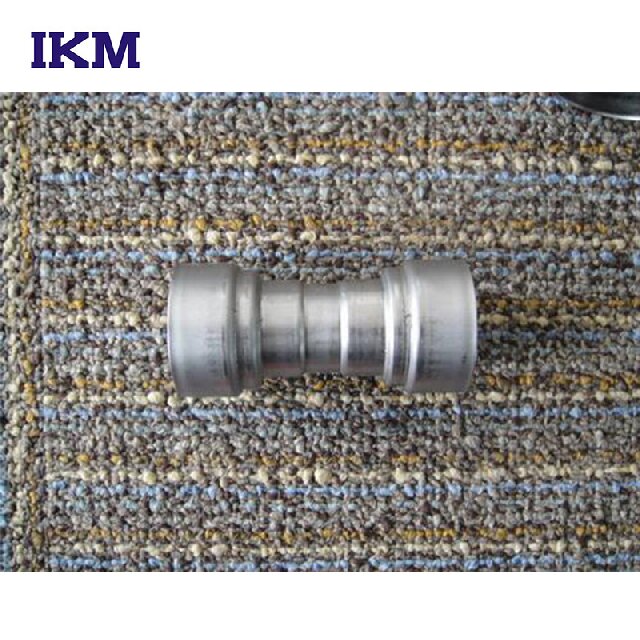
The raw material fundamentally dictates the chosen manufacturing process. Metals behave very differently from polymers under severe stress. Understanding these specific material nuances helps you evaluate supplier capabilities accurately.
During processing, standard 304 stainless steel offers an excellent balance. It maintains high strength while remaining ductile enough for standard cold forming. However, extreme heat environments demand much stronger chemical alternatives. Enter 321 stainless steel. This unique alloy includes critical titanium stabilization. The added titanium prevents chromium carbide precipitation during intense heating or welding. Aerospace components and high-heat exhaust systems rely heavily on 321 stainless steel. If your manufacturer treats 321 exactly like 304, you risk severe structural degradation down the line.
Engineered plastics follow a completely different manufacturing pathway. The extrusion process involves heating raw resin pellets carefully. The machinery melts the resin and pushes it through highly specific metal dies. Die design dictates the ultimate structural integrity of the plastic part. For example, modern high-end facilities use basket dies. Basket dies successfully eliminate knit lines. Knit lines represent common weak points in extruded plastics.
After extrusion, the polymer requires controlled vacuum cooling and sizing. Dropping hot plastic straight into uncontrolled cold water creates severe residual stress. This thermal shock leads to dangerous brittleness over time. Proper vacuum sizing ensures the plastic cools uniformly. It allows the component to maintain its precise outer dimensions without weakening the internal matrix.
Many buyers completely misunderstand the final stages of production. Proper post-processing transforms a raw forging into a reliable, installation-ready component. You must know what happens after the metal cools.
Heat treatment leaves metal surfaces covered in dark oxidation, rust, and scale. Manufacturers remove this through a highly specific chemical process called pickling. They submerge the stainless steel fittings in carefully controlled acidic baths. The strong acid strips away all surface impurities efficiently. It leaves behind a clean, passive layer. This passive layer strongly resists future environmental corrosion.
This brings us to a very common engineering misconception. High-quality forged or hot-formed steel often features a smooth, matte finish. To the untrained eye, this finish looks identical to a cheap cast component. Buyers often worry they received a lower-grade product. You can confidently reassure your engineering teams. This matte uniformity is the direct result of precision chemical pickling. It indicates exceptional surface chemistry. It does not indicate a flawed or inferior casting method.
Once thoroughly cleaned, components head directly to the machining floor. CNC lathes and multi-axis mills play a vital role here. They finalize critical features like threading and beveling. Exact dimensional tolerances must be achieved before final inspection occurs. A high-quality CNC pass ensures the fitting mates perfectly with connecting pipes in the field. Bad machining ruins an otherwise perfect forging.
You cannot evaluate a manufacturer solely on a beautifully designed website. Real trustworthiness lies deeply hidden within their testing protocols and daily factory conditions.
Credible manufacturers willingly provide transparent documentation. They must supply physical property tests for every single batch produced. For metal fittings, demand comprehensive ultrasonic testing reports. Ultrasonic waves detect hidden internal flaws that standard visual inspections miss entirely. Dimensional caliper checks ensure the geometry meets tight engineering tolerances.
Plastic components require completely different destructive tests. Quality inspectors follow ASTM D1599 standards for burst pressure testing. They push the pipe to its absolute breaking point. They also conduct sustained pressure tests to simulate years of long-term field use. Finally, bend-back testing forcefully bends the plastic to verify complete fusion integrity. If the plastic cracks under stress, the entire batch fails immediately.
We must also view manufacturing through a strict supply-chain risk perspective. Environmental, Health, and Safety (EHS) standards act as a silent indicator of overall quality. Disorganized, dirty factories rarely produce precision engineering. Facilities lacking OSHA-equivalent safety standards usually demonstrate poor process control across the board. If workers lack proper personal protective equipment (PPE) and shop floors are covered in debris, defect rates will invariably rise. We highly advise buyers to request recent factory audit videos. You should also demand third-party EHS compliance certificates before shortlisting any new overseas supplier.
Procurement teams must translate this technical knowledge into actionable sourcing strategies immediately. Finding the right partner means aligning their factory capabilities with your exact project needs.
Do not needlessly over-specify your engineering requirements. Match your volume and pressure demands directly with the supplier’s specific tooling capabilities. For example, demanding a closed-die forging process for a low-volume, custom prototype makes little sense. It drives up tooling costs unnecessarily and delays production. Conversely, never accept cheaper cold extrusion methods for critical high-pressure offshore lines. You must strike a balance based on application realities.
Use this practical checklist when auditing potential suppliers:
Request Material Test Reports (MTRs): Ensure traceable metallurgical histories for all alloys used.
Verify Specific Equipment: Ask detailed questions about hydraulic press tonnage and CNC machining capabilities.
Validate International Standards: Check for strict adherence to ASME B16.11, ASTM A105, or relevant AWWA codes.
Review Heat-Treatment Logs: Confirm their temperature controls exactly match the specific alloy requirements.
It is time to move beyond simple spreadsheet price negotiations. Initiate deeper technical dialogues with your shortlisted suppliers today. Focus your questions specifically on their defect-reduction strategies. Challenge them to explain their destructive testing protocols in detail. A truly reliable partner will welcome these technical inquiries with transparent data and open factory doors.
The overall safety of any industrial piping matrix connects directly to the rigor of its manufacturing environment. Cutting corners during heat treatment or die pressing inevitably leads to catastrophic field failures. Informed procurement requires looking well beyond the final physical geometry of the component. It demands an understanding of the molecular journey the product took.
Next steps for your sourcing strategy:
Evaluate the complete metallurgical history of the components you intend to purchase.
Verify the surface chemistry protocols, ensuring proper pickling and passivation are standard factory practice.
Audit the facility's safety and cleanliness, as these elements strongly reflect the manufacturer's overall commitment to precision control.
Demand comprehensive destructive testing reports before signing any large-volume purchase agreements.
A: Hot forming introduces high heat to the metal, significantly lowering its deformation resistance. This allows manufacturers to shape thick-walled components using much less mechanical force. Furthermore, the applied heat improves the metallurgical grain structure, greatly enhancing the final product's yield strength and ductility for high-stress applications.
A: Forged components are shaped under extreme compressive forces, resulting in a dense, uniform grain structure with absolutely zero internal porosity. This makes them ideal for critical, high-pressure ratings. Cast fittings are made by pouring molten metal into molds, which can occasionally trap air and create weak micro-voids.
A: High-quality forged or hot-formed stainless steel often has a smooth, matte appearance. This visual trait results from a chemical process called pickling. The fittings are submerged in a highly controlled acidic bath to remove heat-treatment scale and oxidation, creating a clean, uniform finish that simply mimics casting.
A: Manufacturers subject PE plastics to strict destructive testing protocols. They use ASTM D1599 burst pressure testing to find the absolute failure point of the component. They also employ sustained pressure tests to simulate long-term field conditions and bend-back tests to verify that fusion joints will not become dangerously brittle over time.


