


Views: 0 Author: Site Editor Publish Time: 2026-10-14 Origin: Site


Precision in pipe and tube bending requires more than sheer force. It requires exact, repeatable pressure control to maintain structural integrity. Variations in hydraulic pressure during the bending cycle directly cause the most common manufacturing defects. These include wrinkling, ovality, and wall thinning. When pressure fluctuates, the material behaves unpredictably. Understanding how different machinery controls this pressure is critical. You must evaluate a Hydraulic Tube Bender carefully. You want to ensure it meets your production tolerances. Proper evaluation reduces scrap rates. It also delivers a highly positive return on investment. In this article, you will discover how fluid dynamics dictate final geometry. We will explore the mechanics behind rejected parts. You will learn to match machine capabilities to specific material requirements. We will outline the evaluation dimensions necessary for procurement. This guides you toward scaling your manufacturing quality confidently.
Pressure dictates geometry: Consistent hydraulic force on the pressure die prevents the intrados from wrinkling and the extrados from excessive thinning.
Machine capabilities vary: The control systems—ranging from basic manual valves to advanced proportional hydraulics in a two-axis CNC hydraulic bender—determine the repeatability of the bend.
Thermal dynamics matter: Hydraulic fluid temperature fluctuations alter viscosity, which can lead to pressure drops and inconsistent bend quality over a long production shift.
Tooling synergy is required: Even the most precise hydraulic pressure cannot compensate for worn mandrels or incorrect wiper dies.
Manufacturers measure production success through very strict parameters. Achieving zero-defect bending stands as the ultimate goal. You want parts to exit the machine ready for assembly. You must minimize post-process finishing. Operators need to maintain specified wall thicknesses consistently. They also require strict adherence to exact bend radii. When hydraulic systems fail to deliver steady force, these success criteria collapse rapidly.
You need to understand the mechanics of scrap. Uncontrolled hydraulic force destroys good material. Clamp dies and pressure dies rely entirely on fluid power. They hold the tube against the rotary draw bend die. If hydraulic pressure drops, the tube slips. Slippage ruins the bend angle. If pressure spikes aggressively, the tooling crushes the tube. Both scenarios lead directly to rejected parts. Wasted metal and lost labor hours destroy your profit margins.
Table: The Defect Matrix and Hydraulic Root Causes
Defect Type | Physical Description | Hydraulic Root Cause |
|---|---|---|
Wrinkling | Material on the inside of the bend (intrados) bunches up instead of compressing smoothly. | Insufficient hydraulic pressure fails to contain the material against the wiper die. |
Flattening/Ovality | The tube loses its round shape, particularly on the outside curve (extrados). | Unstable pressure during the rotary draw process fails to support the tube's natural tendency to collapse. |
Springback Variance | The bent tube releases its shape unpredictably after unclamping, missing the target angle. | Inconsistent clamping pressure alters the material's memory and stress distribution during the bend. |
Every fabrication shop faces different material challenges. You cannot solve every problem using the same equipment. Manufacturers categorize bending machines based on their hydraulic control sophistication. You must match the machine type directly to your specific production demands.
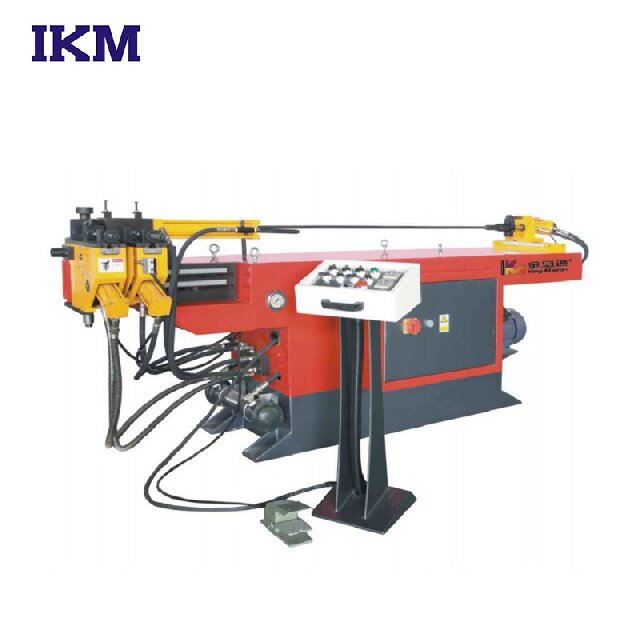
Entry-level solutions serve basic fabrication needs. A standard hydraulic pipe bending machine relies on simple directional valves. These units work best for low-volume runs. They handle low-complexity bends well. Operators can make minor manual adjustments easily. You choose these machines when your project allows higher dimensional tolerances. They provide raw power but lack nuanced control.
Mid-tier precision introduces programmatic consistency. The TNC hydraulic tube bender fills this role perfectly. TNC stands for Touch Screen Numerical Control. This system offers programmable bend angles. It provides reliable, uniform hydraulic pressure application. Operators save pressure settings digitally. This eliminates manual guesswork between shifts. These machines excel in semi-automated environments. They handle single-axis production runs with high repeatability.
High-end automation tackles the toughest manufacturing challenges. The two-axis CNC hydraulic bender represents the peak of pressure control. It utilizes advanced closed-loop hydraulic systems. It employs highly sensitive proportional valves. These components dynamically adjust pressure in real-time during the bending cycle. Aerospace and automotive industries require this technology. You need this level of control for thin-wall bending. It maintains the tightest possible tolerances consistently.
Chart: Bending Machine Capabilities Comparison
Machine Category | Valve Technology | Pressure Adjustability | Best Application |
|---|---|---|---|
Standard Hydraulic | On/Off Directional | Manual / Static | Thick-wall pipe, structural frames, low volume |
TNC Hydraulic | Digital Solenoid | Programmable / Uniform | Furniture, handrails, semi-automated runs |
Two-Axis CNC | Closed-Loop Proportional | Real-Time Dynamic | Aerospace, automotive exhaust, thin-wall tubes |
Evaluating a bending machine requires looking past basic marketing specifications. You must examine the underlying engineering. Hydraulic systems vary wildly in quality. Focusing on specific technical dimensions ensures you purchase capable equipment. We recommend analyzing four critical areas before making a decision.
Hydraulic Valve Technology: You must look for proportional directional control valves. Avoid machines using standard on/off valves for precision work. Proportional valves allow smooth acceleration. They also decelerate the bend arm gently. Sudden stops and starts create massive pressure spikes. These spikes transfer directly into the tube, causing instant deformation.
System Tonnage and Headroom: Never buy a machine that barely meets your maximum requirement. You should specify a machine operating at 70-80% of its maximum hydraulic capacity. This ensures stable, continuous pressure. Running constantly at 100% capacity invites disaster. It risks internal pressure bleed. It also pushes fluid temperatures dangerously high. Headroom guarantees operational stability.
Thermal Management: Heat destroys hydraulic consistency. You must evaluate the machine's oil cooling system carefully. Manufacturers offer air-cooled and water-cooled options. Consistent oil temperature equals consistent fluid viscosity. When viscosity remains stable, pressure delivery remains entirely predictable. If oil overheats, it thins out. Thin oil slips past internal seals, dropping your bending pressure unexpectedly.
Material-to-Pressure Ratios: Different metals demand different handling. Ensure the machine's pressure adjustability is highly sensitive. It must handle thin-walled aluminum without crushing the extrados. Yet, it must remain robust enough to bend heavy-schedule stainless steel. The hydraulic system must bridge this gap seamlessly. Look for systems offering fine-tuned micro-adjustments.
Upgrading your bending equipment brings new operational challenges. Many fabricators make dangerous assumptions about hydraulic technology. Understanding these implementation realities prevents costly downtime. We observe several common pitfalls in the industry.
The Tooling Fallacy: You cannot fix bad tooling with good hydraulics. Many managers assume upgraded hydraulic pressure solves all quality issues. This is false. High hydraulic precision requires perfectly matched tooling. Your mandrels must fit exactly. Wiper dies must feature correct rake angles. Clamp dies need optimal grip length. Hydraulic force simply amplifies the quality of your tooling setup.
Setup and Calibration: Advanced machines demand advanced operators. High-tier CNC benders require skilled personnel. Operators must understand how to program pressure offsets. Different material heats behave differently. A batch of steel from one mill might yield differently than another. Operators calibrate pressure settings constantly to account for these metallurgical variances.
Maintenance Infrastructure: Modern hydraulics demand clinical cleanliness. Hydraulic systems require strict fluid cleanliness protocols. We recommend following ISO 4406 standards. Contaminated oil damages proportional valves immediately. Microscopic metal flakes cause valve stiction. This immediately degrades bend quality. You must invest in high-quality filtration. You must also enforce regular fluid analysis schedules.
Moving from evaluation to procurement requires a structured approach. You want to eliminate guesswork entirely. Base your purchasing decision on empirical data. Follow a strict shortlisting logic to protect your investment.
First, define your material extremes. Audit your current and future production queue. Identify the thinnest walls you process. Identify the toughest alloys you bend. Use these exact materials as your baseline for pressure requirements. Do not size the machine for your average work. Size it for your most difficult parts.
Next, request comprehensive capability studies. Do not buy based on specification sheets alone. Sales brochures rarely tell the whole truth. Require the OEM to perform a test bend. Make them use your specific raw material. Demand a destructive testing report afterward. Analyze the wall thinning on the extrados. Measure the ovality. Let the physical evidence guide you.
Finally, perform a strict ROI calculation. Weigh the upfront cost of advanced hydraulic control against your current losses. Calculate the annualized cost of scrap metal. Calculate the labor hours spent on manual rework and finishing. Compare this total waste against the machine's purchase price. Precision hydraulics often pay for themselves rapidly simply by eliminating daily scrap.
Hydraulic pressure serves as the invisible variable in fabrication. It dictates the physical outcome of every single bend. Relying on manual pressure estimation leads to inconsistent quality. Moving to programmatic, closed-loop control is the surest path to scaling your production.
You must align the sophistication of your hydraulic system with your strictest compliance requirements. Evaluate your current scrap rates honestly. Audit your hydraulic cooling and valve technologies. Take action by requesting destructive capability studies from vendors. Finalize your procurement only when the empirical data proves the machine meets your standards.
A: Consistent clamping and bending pressure yields a predictable amount of springback. When hydraulic force remains perfectly stable, the material's memory releases uniformly. This allows operators to accurately over-bend the material during the programming phase, knowing it will relax back to the exact target angle.
A: While retrofitting a basic machine with proportional valves and modern PLCs is possible, it rarely makes sense. The mechanical frame often lacks the rigidity for such upgrades. It is generally more cost-effective to invest in a modern TNC or CNC unit to guarantee systemic reliability.
A: The pressure die applies lateral hydraulic force against the tube. It keeps the material pressed tightly against the rotary bend die throughout the cycle. If hydraulic pressure drops, the die slips backward. This lack of support results in severe wrinkling along the inner radius.


