


Views: 0 Author: Site Editor Publish Time: 2025-11-20 Origin: Site


In today’s highly competitive manufacturing landscape, precision and efficiency are more important than ever. Industries that rely on pipe bending, such as automotive, aerospace, HVAC, and construction, are constantly seeking ways to improve both the accuracy of their products and the speed at which they are produced. Full electric pipe bending machines have emerged as a game-changer in this regard, offering a new level of performance compared to traditional hydraulic and mechanical bending systems.
These machines replace the conventional hydraulic systems with electric motors, enabling more precise control and better overall efficiency. In this article, we’ll explore how full electric pipe bending machines are improving precision and efficiency in the manufacturing industry, and why they are becoming a crucial investment for modern production lines.
To understand the benefits of full electric pipe bending machines, it’s important to first define what they are. Traditional pipe bending machines often use hydraulic or mechanical systems to apply force to a pipe, causing it to bend. While these systems have served the industry for decades, they come with limitations in terms of energy consumption, accuracy, and maintenance requirements.
Full electric pipe bending machines, on the other hand, replace the hydraulic system with electric servo motors and controllers. These motors provide precise control over the bending process, allowing for more accurate bends, faster operation, and reduced energy consumption. The key feature of electric machines is their ability to program and control each bend with high precision, often to within millimeters, ensuring that the final product meets exact specifications every time.
One of the key advantages of full electric pipe bending machines is the use of servo motors. Unlike hydraulic systems that rely on fluid pressure to create force, servo motors in electric machines provide direct, precise control over the bending mechanism. These motors are capable of adjusting their output according to the specific needs of the task, allowing for millimeter-level accuracy.
Servo motors can execute multiple types of bends with ease, including complex angles and tight radii. The control system can be programmed to perform the bending process repeatedly with the same level of precision, ensuring that every pipe produced has identical bend angles and dimensions. This is especially important in industries like aerospace or automotive manufacturing, where even slight deviations can lead to defective products or costly rework.
Many full electric pipe bending machines come equipped with Computer Numerical Control (CNC) systems, which offer an additional layer of precision. CNC technology allows the operator to input detailed specifications, and the machine will automatically execute the bending process according to those parameters.
The integration of CNC in electric pipe benders enables highly accurate and repeatable bends. It removes the potential for human error, as the process is fully automated once the parameters are set. The operator can monitor the bending process in real-time, making adjustments if necessary, but the machine’s ability to perform programmed bends without constant intervention ensures that each bend is perfectly executed every time.
In addition, CNC systems can be programmed to perform various bending sequences in quick succession. This not only improves precision but also reduces the amount of time spent reconfiguring the machine for different tasks.
Hydraulic systems can suffer from issues like pressure drift or loss of consistency due to fluctuations in fluid pressure. These issues can lead to inaccuracies, especially during long production runs where the system might not maintain the same pressure throughout the process.
Full electric pipe bending machines do not rely on hydraulic fluids, so they are not prone to pressure loss or drift. The direct control provided by the electric servo motors eliminates these concerns, allowing for more stable and accurate bending over extended periods of use. As a result, manufacturers can rely on electric machines to produce high-precision parts consistently throughout a production run, without worrying about variations in performance.
Electric pipe bending machines allow for much finer control over bending parameters compared to hydraulic systems. Factors like bend radius, angle, speed, and force can all be adjusted with great precision through the machine’s interface. This level of control ensures that each bend meets the exact specifications required for the product.
For example, the machine can be programmed to bend the pipe at a specific speed and pressure that is optimal for the material being used, whether it's stainless steel, aluminum, or carbon steel. The ability to adjust these parameters based on the material properties ensures that the pipe does not experience damage, such as wrinkling or cracking, during the bending process. This results in high-quality, precision bends that are both durable and accurate.
With full electric pipe bending machines, there is less room for human error. Traditional machines often rely on manual adjustments, which can lead to slight variations between different batches of parts. Electric machines, especially those integrated with CNC technology, automate most of the process, ensuring that every bend is executed to the exact same standard.
The consistency achieved with electric machines is critical in industries where parts must fit together perfectly, such as in the assembly of vehicle exhaust systems or pipelines for industrial applications. The improved accuracy and repeatability mean that there is less material waste, fewer defects, and a higher rate of first-pass yield.
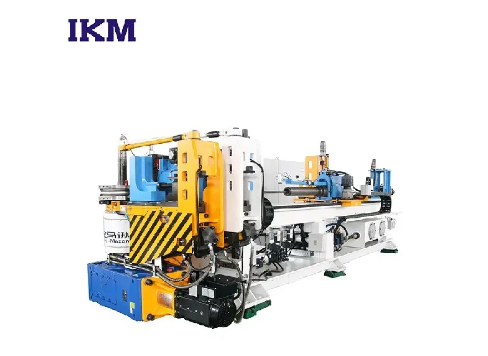
One of the key advantages of full electric pipe bending machines is the speed with which they can be set up and operated. Traditional hydraulic machines often require lengthy setup times to adjust for different pipe sizes, bend angles, or materials. In contrast, electric machines can be quickly reprogrammed or adjusted to accommodate changes in production requirements.
Because electric machines use servo motors to control bending, the machine is immediately responsive to changes in input. Operators can input new bending parameters quickly, and the machine will execute the bends at the required speeds without delay. This reduces the downtime between production runs and increases the overall throughput of the manufacturing process.
Electric pipe bending machines can complete bending cycles faster than their hydraulic counterparts. This is due to the precise control offered by the electric motors, which are capable of faster response times compared to hydraulic systems. In a high-volume production environment, even small reductions in cycle time can lead to significant increases in output.
Furthermore, electric machines can perform more complex bends in a single cycle without the need for multiple adjustments or pauses. This reduces the overall cycle time and improves the efficiency of the entire production line.
Full electric pipe bending machines are far more energy-efficient than traditional hydraulic systems. Hydraulic systems require energy to pump hydraulic fluid through the system, which can be wasteful, especially during idle times or when the system is not operating at full capacity.
Electric machines, however, use energy only when needed, thanks to the precision of the servo motors. This means that they consume less power overall, reducing operational costs and contributing to a more environmentally friendly production process. Manufacturers can benefit from lower energy bills while also meeting sustainability goals by adopting electric machines.
Electric pipe bending machines require far less maintenance compared to hydraulic machines. Hydraulic systems have complex components such as pumps, valves, and hydraulic fluid that need regular maintenance, and they are prone to leaks and wear over time. This can result in increased downtime for repairs and higher operating costs.
In contrast, electric machines have fewer moving parts and do not require hydraulic fluids. As a result, they experience less wear and tear, which translates into reduced maintenance requirements and longer lifespans. Manufacturers can save money on maintenance and reduce the frequency of downtime for repairs.
The high level of automation provided by full electric pipe bending machines allows operators to focus on other tasks, such as quality control or overseeing the production line. With less time spent on machine setup, adjustments, and troubleshooting, workers can become more productive and efficient in other areas of the production process.
In addition, the precision and speed of electric machines reduce the need for manual interventions to correct errors or rework parts. This not only saves time but also improves the overall workflow on the factory floor, leading to greater overall efficiency.
Full electric pipe bending machines are transforming the pipe bending process with unmatched precision and efficiency. They can execute complex bends with millimeter-level accuracy, speed up cycle times, and reduce energy consumption, making them perfect for modern manufacturing. By utilizing electric servo motors, CNC integration, and advanced control systems, these machines are setting new benchmarks in pipe bending technology.
Industries like automotive, aerospace, HVAC, and construction can greatly benefit from the high precision, reduced maintenance, and improved productivity that full electric pipe bending machines offer. For companies seeking to enhance product quality and boost operational efficiency, investing in these machines is a smart choice. As the demand for fast, precise, and sustainable manufacturing continues to grow, these machines will play an essential role in the future of production.


