


Views: 0 Author: Site Editor Publish Time: 2026-08-27 Origin: Site


Transitioning from low-volume fabrication to repeatable mass production exposes critical operational vulnerabilities. You quickly encounter the hidden costs of inconsistent bends, high scrap rates, and excessive operator dependency. Achieving true repeatability requires aligning machine technology, tooling precision, and material behavior predictability. You cannot rely on manual guesswork when producing thousands of identical parts. Minor deviations in setup compound into massive downstream assembly bottlenecks.
This article provides a comprehensive framework for evaluating, specifying, and setting up a production-grade Pipe Bending Machine. You will learn how to define success criteria, select the right technology, and calibrate tooling for optimal results. We explore how modern CNC software mitigates material variables and prevents costly human errors on the shop floor.
By following these technical guidelines, you can ensure consistent dimensional tolerances, minimize machine downtime, and scale your manufacturing processes. Predictable production bridges the gap between raw hardware capabilities and long-term process control.
Technology Dictates Consistency: Upgrading to a full electric pipe bending machine often yields the highest repeatability by eliminating hydraulic fluid temperature fluctuations.
Tooling is the Foundation: Even advanced CNC systems cannot compensate for incorrect mandrel placement or mismatched wiper dies.
Software Prevents Scrap: Modern bidirectional CNC pipe bender systems utilize 3D simulation to predict interference and springback before the first physical cut.
The cost of non-repeatability directly impacts your profit margins. Material waste adds up quickly during high-volume runs. Downstream assembly bottlenecks occur when bent parts do not perfectly fit welding fixtures. Excessive QA intervention slows down the entire shop floor. You must frame the business problem around these hidden inefficiencies rather than just looking at raw production volume.
To evaluate your bending process accurately, you need strict baseline metrics. These indicators reveal the true health of your manufacturing cell. We recommend tracking the following data points:
Cycle Time: Measure the floor-to-floor time per finished part. This includes loading, bending, and unloading.
Cpk/Ppk (Process Capability): Track how well you maintain strict dimensional tolerances across different shifts. High Cpk values indicate a stable, predictable process.
Changeover Time: Calculate the labor hours required to swap tooling for different pipe diameters or bend radii.
Implementation reality often challenges initial expectations. Success is determined not by peak machine speed, but by minimizing downtime. You achieve real efficiency by reducing scrap during the first ten bends of a new batch. A machine running at moderate speeds with zero scrap always outperforms a fast machine that requires constant operator adjustments.
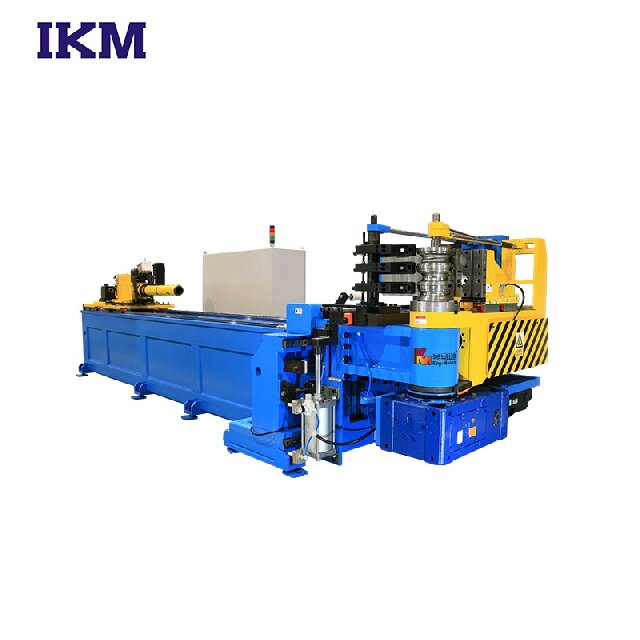
Selecting the right bending equipment dictates your long-term production capabilities. Different industries require distinct mechanical approaches to manipulate metal tubing effectively.
A hydraulic tube bender excels in specific heavy-duty environments. It represents the traditional approach to metal forming. This technology is best for thick-walled pipes, structural steel, and high-torque requirements. Budget-conscious heavy industrial applications often rely on hydraulic systems for their raw power.
However, you must manage its inherent limitations. Hydraulic systems are highly susceptible to thermal expansion. As the pump runs, the hydraulic fluid heats up and changes viscosity. This thermal drift alters the bending force. Operators must perform frequent recalibrations to maintain tight tolerances throughout the day. You cannot simply "set and forget" a hydraulic setup during a multi-shift production run.
A full electric pipe bending machine represents the modern standard for repeatable production. This technology is best for high-volume automotive, aerospace, and precision manufacturing. Instead of fluid dynamics, it relies on advanced electronics.
The advantages of all-electric systems are substantial. Servo-motor control ensures absolute positional accuracy for every axis. A servo motor moves exactly to its commanded position, every single time. This architecture completely eliminates thermal drift. It also reduces ambient acoustic noise on the factory floor. Electric benders provide the strict process capability required by rigorous quality standards like ISO 9001.
A bidirectional CNC pipe bender solves severe geometrical challenges. It is best for complex, multi-radius geometries found in furniture manufacturing, exhaust systems, and HVAC components.
The primary advantage is its left-and-right bending capabilities within a single cycle. Standard machines bend in only one direction. This creates physical interference issues on asymmetrical parts where the tube hits the machine bed. Bidirectional systems dynamically switch bending directions. They eliminate interference collisions and drastically reduce cycle times. You avoid secondary operations and expensive specialized tooling.
Bending Technology Comparison Matrix
Technology Type | Primary Application | Key Advantage | Known Limitation |
|---|---|---|---|
Hydraulic | Thick-wall, structural steel | High torque output | Thermal drift requires recalibration |
Full Electric | Aerospace, automotive | Absolute positional accuracy | Higher initial capital expenditure |
Bidirectional | Complex, asymmetrical parts | Left-and-right bending in one cycle | Complex programming requirements |
Even the most advanced electronic controls fail if the physical tooling is improperly calibrated. The mechanical interaction between the dies and the tube dictates the final part quality. You must apply an expertise lens to tooling dynamics.
Mandrel and wiper die alignment is absolutely essential. The mandrel supports the interior of the tube. The wiper die supports the exterior trailing edge. Correct alignment prevents wrinkling on the inside radius and flattening on the outside radius. Operators must set the rake angle of the wiper die precisely. Too much angle causes wrinkles, while too little angle causes tool wear and galling.
Tight-radius bends demand additional mechanical support. Bends at 1D or 1.5D (where the bend radius equals the tube diameter) stretch the material severely. A pressure die assist becomes necessary for these applications. The pressure die physically pushes the material into the bend zone. This boost force reduces wall thinning and prevents structural failure on the outside of the curve.
Material variables introduce significant implementation risks. Springback remains the most challenging phenomenon in metal forming. When you bend a tube, it naturally attempts to return to its original shape. Different heat lots of the exact same material exhibit varied yield strengths. A batch of 304 stainless steel delivered on Tuesday might spring back differently than a batch delivered on Friday.
Production setups must manage this inconsistency. Modern systems use proportional control and springback compensation software to maintain repeatability. The software senses the yield point during the bend. It calculates the specific springback factor in real-time. It then over-bends the tube by the exact required degree. This closed-loop feedback maintains strict dimensional accuracy despite natural material inconsistencies.
Software bridges the gap between mechanical capability and human execution. Relying on operator intuition leads to scrap and machine damage. You must leverage CNC features to guarantee consistent outcomes across all shifts.
Modern HMI (Human-Machine Interface) systems convert complex features into reliable production outcomes. We evaluate software by looking at three specific capabilities:
3D Bending Simulation: Modern controllers import standard STEP or IGES CAD files. The software runs a full virtual simulation of the bending cycle. It verifies mechanical feasibility and checks for collisions between the tube, the tooling, and the machine frame. This avoids costly physical crashes and prevents material waste during setup.
Springback Database: Advanced software stores historical material data. As you process different batches, the system builds an empirical memory. It automatically over-bends parts based on this stored data. Operators do not have to guess the required over-bend angle for common materials.
Automated Loader/Unloader Integration: True high-volume production requires unattended operation. CNC software must interface seamlessly with robotic cells. Standardized I/O signals orchestrate the handshake between the bender and the robotic arm, ensuring safe and continuous material handling.
Security and compliance also play a massive role in repeatable manufacturing. You cannot allow unauthorized personnel to alter optimized programs. Operators sometimes tweak machine parameters to fix a temporary issue, which ruins the batch consistency. Modern CNC systems enforce role-based access controls. Once an engineer validates a production run, the HMI locks the critical parameters. Operators can run the program, but they cannot change the pressure die boost or mandrel extraction timing without a supervisor's password. This security secures your process capability.
Procuring a production-grade machine requires evidence-oriented evaluation. You should never buy based solely on a brochure specification. Manufacturers often list theoretical maximums that do not translate to real-world performance. You must demand a physical "run-off" test before issuing a purchase order.
Ship your hardest-to-bend part to the machine vendor. Provide the exact material lot you use in production. Force the vendor to prove their machine can hold your required Cpk tolerances across a sample batch of fifty parts. If the machine cannot produce acceptable parts during the run-off, it will not survive your production floor.
Vendor Service Level Agreement (SLA) considerations are equally important. Machine downtime destroys production schedules. When evaluating vendors, investigate their post-sale support infrastructure. Ensure they maintain a strong availability of localized spare parts. Waiting three weeks for a proprietary servo drive from overseas is unacceptable.
You should also require remote diagnostic capabilities. Modern machines feature IoT integration. When a software fault occurs, factory technicians can log into your machine securely over the internet. They can diagnose I/O faults, tune servo parameters, and update firmware remotely. This capability resolves complex issues in hours rather than waiting days for a technician visit.
Your actionable next step is simple. Document your top three highest-volume parts. Record the material grade, outer diameter (OD), wall thickness, and centerline radius (CLR). Use this specific data to establish a baseline Request For Quote (RFQ). Send this standardized RFQ to targeted manufacturers to begin an objective evaluation process.
Repeatable production successfully bridges the gap between hardware capability and process control. Moving from manual or basic systems to advanced, software-driven electric machines safeguards your profit margins at scale. You eliminate the guesswork that causes downstream bottlenecks and excessive scrap rates.
Base your final investment decision on verified performance metrics and the machine's ability to natively handle your specific material variables. Evaluate how well the technology compensates for springback and prevents mechanical interference on complex part geometries.
Take proactive steps today. Consult with an application engineer to review your existing part drawings. Request a detailed cycle-time analysis and a comprehensive tooling feasibility study. By aligning precise tooling with intelligent software, you will achieve genuine manufacturing repeatability.
A: Modern systems utilize quick-change tooling designs and saved software programs to optimize setups. By recalling digital parameters and using standardized mechanical clamps, skilled operators can reduce changeover times from several hours to under 15 minutes.
A: Yes, but it requires significantly more effort. You need advanced proportional valves, rigorous thermal management systems, and frequent manual calibration. Electric equivalents maintain repeatability automatically via servo-motor encoders without requiring constant operator intervention.
A: It is strictly required for parts with complex, asymmetrical shapes. If bending a tube in one direction causes the material to collide with the machine bed or bending head, you need bidirectional capability to flip the bending axis dynamically.
A: Wall thinning occurs when material stretches on the outside of a bend. Proper setup mitigates this through the pressure die assist (boost function) and correct mandrel placement. These tools force material into the bend zone, maintaining structural integrity.


