


Views: 0 Author: Site Editor Publish Time: 2026-10-21 Origin: Site


Scaling metal fabrication requires transitioning from general-purpose cutting to specialized equipment. You must eliminate production bottlenecks to grow efficiently. Choosing between a cold saw and a band saw dictates downstream labor costs. Your choice directly affects secondary operations like deburring and edge finishing. Making the wrong equipment decision drains your profit margins rapidly.
We provide a strict, evidence-based evaluation framework below. You will learn how to match machine capabilities to specific volume, tolerance, and operational requirements. We aim to help production managers and shop owners make informed choices. By analyzing mechanical profiles and production capacities, you can confidently invest in the right cutting technology.
Metal circular saw machines (cold saws) deliver milled-finish, burr-free cuts ideal for precise, thin-to-medium wall tube processing, heavily reducing secondary operation costs.
Band saws excel in raw capacity, bundle cutting, and handling large-diameter structural materials where finish quality is secondary to throughput.
The true cost per cut must factor in blade lifespan, cycle times, and the labor required for deburring.
Upgrading to an automatic tube cutting machine amplifies the ROI of cold saws in high-volume, repeatable batch processing.
Metal fabrication shops eventually hit a processing ceiling. Multi-purpose tools fail at high production volumes. We must define clear success criteria to solve this bottleneck. Assess whether your primary goal is increasing raw throughput or maximizing cut quality. Throughput focuses on moving tons of material per shift. Quality focuses on eliminating downstream deburring entirely.
Many shops ignore the hidden cost of secondary operations. A cheaper initial cut on a band saw often hides massive labor expenses. You pay operators to manually finish edges before welding. CNC bending processes require perfect tube edges to prevent defects. These manual finishing steps destroy your production efficiency.
You must identify the exact volume threshold for upgrading. General shop saws work fine for occasional tasks. However, high-volume batches demand specialized solutions. Transitioning to a dedicated Tube Cutting Machine outperforms standard multi-purpose tools. It centralizes your cutting operations. It creates a predictable flow of ready-to-weld materials.
Best Practice: Audit your current workflow. Track how many hours your team spends deburring edges each week.
Common Mistake: Buying a saw based solely on the initial machine price. This ignores the daily labor costs of manual edge finishing.
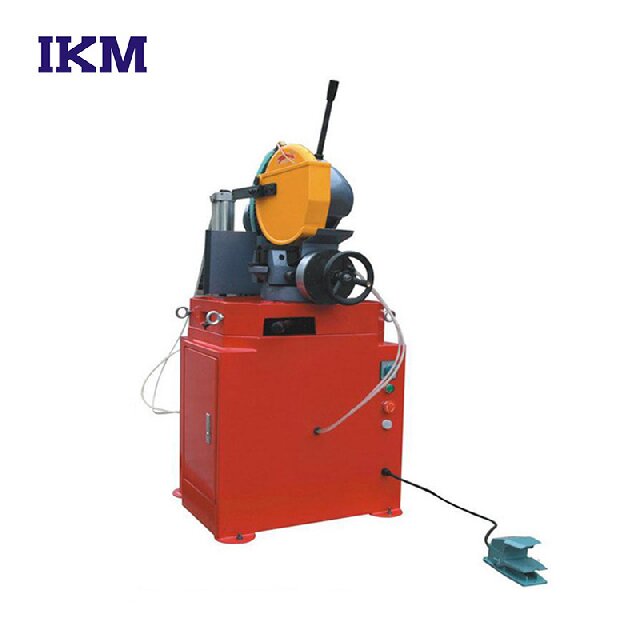
A metal circular saw machine operates using low-RPM and high-torque mechanics. It transfers heat directly to the metal chip rather than the tube itself. This process preserves the metal metallurgy perfectly. It prevents work hardening on the cut edge. You get a clean, chemically unchanged surface.
These machines offer distinct primary advantages. They deliver incredible squareness and tight tolerances. Minimal blade deflection ensures accurate angles every single time. Operators receive a burr-free, ready-to-weld milled finish. Cycle times are incredibly fast on small to medium-diameter tubing. You eliminate the entire deburring department.
System upgrades enhance these capabilities further. Adding a Hydraulic Metal Circular Saw Machine provides exceptionally rigid clamping. It delivers consistent feed rates automatically. Hydraulic vice jaws prevent thin-wall tube deformation during clamping. They secure the material firmly without crushing it.
However, cold saws possess strict operational limitations. Blade diameter heavily restricts your maximum cutting capacity. It is typically impractical for tubes exceeding 6 to 8 inches in diameter. You face higher initial consumable costs. You must also manage blade sharpening logistics carefully.
The horizontal band saw features a distinct mechanical profile. It uses a continuous loop blade moving in one direction. These blades feature variable tooth pitches. They suit a wide range of shapes and solid blocks. The mechanics allow the machine to cut massive profiles easily.
Band saws provide several primary advantages for heavy industry. They offer superior capacity for large-diameter tubes. They process heavy structural sections without stalling. You can effectively cut nested bundles of material simultaneously. Furthermore, you enjoy a much lower initial cost per blade.
Despite their raw power, band saws have operational limitations. Blade deflection causes the cut to wander frequently. This wandering worsens on thin-wall tubes or when using dull blades. The rougher surface finish necessitates secondary deburring. Individual cut cycle times remain significantly slower compared to circular saws.
Table: Quick Comparison of Machine Capabilities
Feature | Metal Circular Saw Machine (Cold Saw) | Horizontal Band Saw |
|---|---|---|
Surface Finish | Milled, burr-free, ready to weld | Rough, requires manual deburring |
Blade Mechanics | Rigid circular disk, zero deflection | Flexible continuous loop, prone to wandering |
Maximum Diameter | Limited (typically under 6-8 inches) | Excellent for large structural materials |
Bundle Cutting | Possible but limited | Highly effective |
Wall thickness plays a major role in equipment selection. Thin-wall and heavy-wall tubes require completely different handling. Cold saws prevent crushing on thin walls. They utilize specialized multi-point clamping systems. Band saws prove highly efficient on heavy-wall solids. They chew through thick steel effortlessly.
Material hardness dictates your cutting geometry. You must select specific tooth profiles carefully. Use High-Speed Steel (HSS) blades for standard carbon steel applications. Choose Tungsten Carbide Tipped (TCT) blades for hard stainless steel. Aluminum requires specialized rake angles to clear chips effectively. Matching the blade to the material extends tool life significantly.
We must analyze individual cut cycle times. Cold saws easily outpace band saws on single-tube cuts. They slice through the material rapidly. A band saw requires a slower, more deliberate downfeed. If you process hundreds of individual tubes daily, cold saws win easily.
Automation scalability changes the entire production equation. Integrating an Automatic Tube Cutting Machine maximizes output. You can add bundle loaders, auto-feed systems, and auto-sorting ramps. This automation heavily favors the rigid mechanics of a circular cold saw. It enables true high-volume, lights-out manufacturing. Your operators simply load bundles and walk away.
Assess your daily tube processing volume.
Calculate the time operators spend loading single tubes manually.
Determine if an automatic feeder justifies the capital investment.
Understanding blade economics directly impacts your daily operating budget. Band saw blades are entirely disposable. You discard them once they become dull. Cold saw blades are highly resharpenable. You can send them out for grinding multiple times. You should calculate your cost per cut over 10,000 cycles to see the real efficiency.
Coolant and maintenance routines ensure machine longevity. Both machines require proper fluid management systems. However, perfect coolant flow is critical for cold saw blade survival. Flood coolant removes heat and flushes chips aggressively. This prevents the teeth from chipping. Neglecting coolant mixtures destroys expensive blades in minutes.
Best Practice: Use a refractometer to check coolant concentration daily. Maintain the exact ratio recommended by the manufacturer.
Common Mistake: Running a cold saw dry on carbon steel. This overheats the blade and ruins the temper instantly.
Evaluate your available footprint and material handling space. Assess your shop floor layout accurately. You need adequate room for in-feed and out-feed roller tables. Band saws often require much larger linear footprints. Handling twenty-foot structural beams demands significant open space.
Power and utility constraints often surprise shop owners. Review your electrical phase requirements early. Single-phase power severely limits your machine options. Industrial high-torque cold saws require strict 3-phase power. Verify your facility panel can handle the required amperage before purchasing equipment.
Operator safety and ergonomics demand serious attention. Modern circular saws feature fully enclosed cutting zones. This protects operators from flying chips and rotating parts. Band saws often pose exposed blade risks during operation. Consider noise level compliance in your facility. Implement strict chip management protocols to maintain a safe floor.
Choosing the correct saw transforms your production capabilities. Choose a cold saw for high-precision, low-secondary-op tube processing. It keeps your edges clean and ready for welding. Choose a band saw for high-mix processing. It dominates large-diameter materials or high-capacity bundle cutting.
Follow these actionable next steps to finalize your decision:
Request a detailed time-study from your machine OEM.
Send your specific tube material for a sample cut.
Physically inspect the finished edges to verify cut quality.
Evaluate the floor space requirements against your current layout.
A: No, band saws inherently leave micro-burrs on metal tubes. The flexible blade design and aggressive tooth geometry tear the material slightly as it exits the cut. You will nearly always need manual deburring. Cold saws, conversely, use rigid blades to mill the material, leaving a perfectly clean finish.
A: Most standard cold saws max out around 6 to 8 inches in diameter. The maximum cut relies directly on the blade-to-material ratio. The blade diameter must be large enough to pass through the entire tube while clearing the central hub. Larger tubes require band saws.
A: It depends on your growth trajectory. Low-volume shops may struggle to reach the break-even point quickly. However, automatic machines allow you to reallocate labor to welding or assembly. If setup times remain short, the long-term labor savings often justify the investment for growing shops.
A: Generally, yes. Flood coolant flushes chips and controls heat perfectly. However, many modern cold saws now use Minimum Quantity Lubrication (MQL) or misting systems. MQL applies precise oil droplets to the cutting edge, reducing messy cleanups. Dry cutting is only suitable for specialized dry-cut saws.


