


Views: 0 Author: Site Editor Publish Time: 2026-10-16 Origin: Site


Upgrading tubular part production requires balancing upfront capital expenditure against long-term cycle time reductions. Manufacturers constantly seek reliable ways to maximize output without overspending on unnecessary automation. For manufacturers handling structural tubes, automotive exhausts, or fluid transfer lines, the bottleneck often lies in end forming. The choice of machinery directly dictates your floor layout, operator headcount, and overall throughput capabilities. Deciding between single-head and double-head systems involves complex trade-offs regarding facility space and part variations. This guide breaks down the operational realities, capability limits, and ROI frameworks to help engineering and procurement teams make an evidence-based selection. You will learn how to accurately evaluate your current production constraints and choose the ideal machine architecture.
Throughput vs. Flexibility: Single-head machines prioritize tooling flexibility and frequent changeovers; double-head systems drastically reduce cycle times by processing both ends simultaneously.
Volume Thresholds: A double-head end forming machine typically justifies its higher CapEx when producing high-volume, symmetrical, or dual-end processed parts.
Hidden Costs: Double-head systems require tighter material length tolerances and more complex maintenance protocols for dual hydraulic/servo systems.
Scalability: Both machine types can integrate with multi-station tooling, but automating the material feed is highly dependent on the chosen head configuration.
Before purchasing new equipment, you must accurately diagnose your factory floor constraints. Upgrading machinery without understanding the root cause of delays often shifts the bottleneck down the line rather than solving it.
Identify the primary constraint in your current workflow. You need to ask specific operational questions. Is your current hurdle raw cycle time? Are you paying too much for manual labor to flip parts? Do you see massive piles of work-in-progress (WIP) inventory accumulating between separate forming stations? Addressing these questions clarifies whether you need raw speed or process flexibility.
Cycle Time Delays: The machine simply cannot process parts fast enough to meet downstream assembly demands.
Labor Cost Inefficiencies: Operators spend too much time handling materials instead of letting the machine work.
WIP Inventory Buildup: Sequential processing creates staging delays. Parts sit in bins waiting for the second end to be formed.
Manual material handling introduces hidden inefficiencies. Turning a heavy or excessively long tube to form the second end wastes valuable seconds. An operator might take five to eight seconds just to flip a two-meter exhaust pipe. This manual flipping introduces severe ergonomic risks. Worker fatigue leads to alignment errors. Misaligned tubes result in scrapped parts and machine jams. Over an eight-hour shift, those wasted seconds compound into hundreds of lost production units.
Establish a strict baseline before evaluating any machine upgrades. Determine your current cost per part. Calculate the exact cycle time from the moment a raw tube enters the cell to the moment the finished part leaves. Once you possess these hard metrics, you can mathematically justify the capital expenditure of a new system based on projected labor savings and increased throughput.
Many facilities start with single-head technology. These systems provide a reliable, straightforward approach to tubular manipulation. They remain a staple in job shops and contract manufacturing facilities worldwide.
Single-head units require a significantly lower initial capital expenditure. They feature a compact machine footprint. You can easily integrate them into crowded production cells. Furthermore, operator training remains highly simplified. New technicians can learn to operate and troubleshoot a standard Tube End Forming Machine in a matter of hours. The single-axis motion reduces the complexity of the control interface.
Tooling swaps define the agility of single-head units. Operators only need to change one set of clamps and one set of forming punches. This rapid changeover makes single-head units ideal for high-mix, low-volume (HMLV) environments. Contract manufacturers who process dozens of different part numbers per week rely heavily on this agility. You can transition from expanding a 2-inch pipe to reducing a 1-inch pipe with minimal downtime.
Agility comes with a distinct throughput penalty. Forming two ends of a single tube requires double the handling time. The operator forms the left side, extracts the tube, flips it manually, and inserts the right side. Alternatively, you can stage two single-head machines in sequence. However, this approach doubles your required floor space. It also demands either two operators or a complex robotic transfer system between the two machines. Sequential processing inherently increases your labor dependency and expands your required WIP staging footprint.
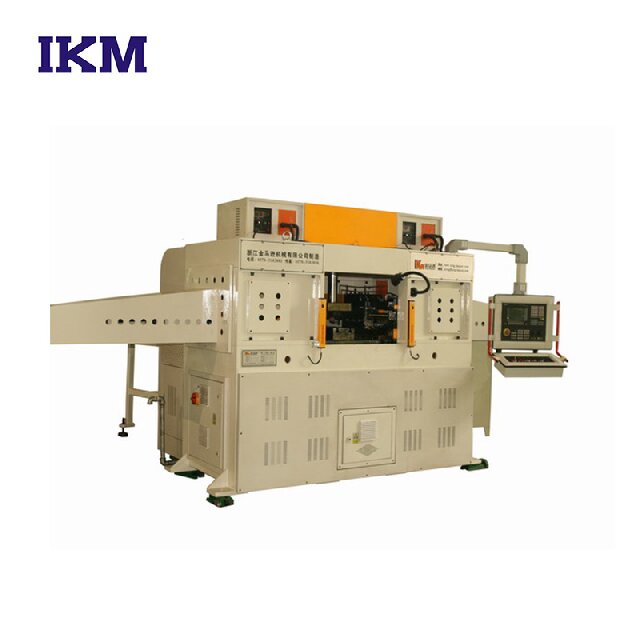
When production volumes scale, handling time becomes the ultimate enemy of profitability. Double-head systems eliminate the part-flip. They process both ends of the tubular component at the exact same time.
Processing both tube ends simultaneously effectively halves the actual forming cycle time. The machine drops the tube into the clamping dies. The dies secure the part. Both left and right forming heads advance simultaneously. They strike the tube ends, retract, and the clamps open. The finished part drops out. You completely eliminate the ergonomic strain of manual flipping. This simultaneous action creates a massive increase in shift output, easily justifying the initial capital investment for high-demand projects.
Double-head configurations excel in specific manufacturing verticals. They are perfect for a Dual-Head Precision End Forming Machine for High-Volume Pipe Fittings. You will also see them dominating the production of automotive shock absorbers, cross-car beams, and symmetrical tubular frames. Any application demanding hundreds of thousands of identical parts annually benefits immensely from dual-head processing. Symmetrical forming requirements maximize the utility of these machines.
Sequential forming struggles with tolerance stacking. When you flip a part, you establish a new datum point for the second strike. This often leads to variations in the overall length (OAL) of the finished part. Double-head machines solve this elegantly. By clamping the tube exactly once and forming both ends simultaneously, the machine maintains strict OAL and concentricity tolerances. The single clamping action fixes the datum point perfectly. This guarantees unmatched consistency across massive production runs.
Procurement teams need hard data to compare these architectures. You must evaluate how each system integrates into your broader manufacturing ecosystem.
Calculating payback requires mapping labor savings against capital expenditure. You must calculate the exact labor savings of eliminating the part-flip. If a dual-head unit saves six seconds per part, and you produce one million parts annually, you save 1,666 labor hours. Multiply those hours by your fully burdened labor rate. Compare this annual savings against the higher upfront cost of the dual-head unit. In high-volume scenarios, the payback period often shrinks to less than eighteen months.
Multi-strike operations require careful consideration. You must compare how a Multi-Station End Forming Machine setup works in both contexts. A single-head multi-station machine shifts the tube vertically or horizontally to strike one end multiple times (e.g., expand, then bead, then thread). A double-head machine can also feature multi-station capabilities, performing sequential strikes on both ends simultaneously. However, coordinating a multi-station, multi-strike operation on two heads simultaneously requires highly sophisticated servo controls and flawless tooling alignment.
Real estate on the factory floor carries a premium cost. You must compare the footprint of one double-head machine versus two single-head machines. Two single-head units require a large WIP staging area between them. Operators need space to stack half-finished tubes safely. One double-head machine consumes slightly more space than a single unit, but it completely eliminates the intermediate WIP staging zone. This significantly condenses your required cell footprint.
Capability Comparison: Single-Head vs. Double-Head Systems
Evaluation Criteria | Single-Head Systems | Double-Head Systems |
|---|---|---|
Capital Expenditure | Lower initial investment. | Higher upfront cost. |
Cycle Time (Two Ends) | Slower (requires manual flip). | Fast (simultaneous processing). |
Changeover Speed | Rapid (ideal for high-mix). | Slower (requires dual calibration). |
Tolerance Control (OAL) | Prone to tolerance stacking. | Exceptional strict datum control. |
Floor Space Utilization | High (if staging WIP between two units). | Highly efficient (no WIP staging needed). |
Removing the operator entirely remains the ultimate goal for high-volume cells. Double-head units pair exceptionally well with automated material loaders. You can easily integrate gravity-fed magazines or walking-beam systems. The automation drops a raw tube into the machine, both ends form, and the part ejects automatically. Automating a single-head machine for a two-end process requires a highly complex, six-axis robotic arm to extract, flip, and re-insert the part. This drastically increases the integration cost and programming complexity.
No manufacturing technology exists without distinct operational trade-offs. You must anticipate the hidden challenges of upgrading your forming capabilities.
Double-head machines demand strict control over incoming raw materials. Cut-length tolerances must remain exceptionally tight. If a raw tube enters the machine 3mm too short, the simultaneous strike might fail to engage the material fully on one side. This causes uneven forming. Conversely, if the tube is too long, the machine might suffer clamping failures or tooling collisions. Single-head machines forgive length variations more easily because you manually register each end against a physical stop.
Dual systems require advanced troubleshooting skills. Managing dual hydraulic power units or synchronized dual servo-drives introduces layers of complexity. If the left head advances milliseconds faster than the right head, it can push the tube out of the clamp. Maintenance teams must routinely calibrate the advance speeds and clamping pressures of both sides. This requires higher-level technical training compared to maintaining a basic single-axis system.
Your upfront tooling inventory costs will double. You must purchase left-hand and right-hand clamp dies, along with duplicate punch tools. Furthermore, tooling changeovers become highly critical events. Misalignment between the left and right heads during a setup change can lead to immediate, high scrap rates. Operators must systematically calibrate the centerlines. If the dies are off by a fraction of a millimeter, the finished part will suffer from severe concentricity defects.
Choosing the correct equipment requires a logical framework. Apply these straightforward rules to filter your options rapidly.
Evaluate Volume and Part Mix: Analyze your annual production demands. Look at the number of unique part SKUs you process weekly.
If Volume is Low / High-Mix: Default to a single-head multi-station machine. This preserves your cash flow. It maximizes your adaptability. You can change setups quickly to accommodate smaller contract orders.
If Volume is High / Low-Mix: Prioritize a double-head machine. This locks in exceptionally low per-part costs. It allows you to automate the cell entirely. You will win massive contracts based on sheer output speed.
Assess Material Quality: Ensure your upstream cutting processes can hold the tight length tolerances required by dual-head systems. If your saws cut inconsistently, fix that process first.
Next-Step Action: Request a customized time-study from the OEM. Provide your specific part prints. Demand estimated cycle times and guaranteed tooling changeover durations. Base your final decision on these concrete, contractual metrics.
The choice between these systems rarely centers on which machine is objectively better. Instead, you must determine which architecture aligns perfectly with your facility’s specific volume demands, labor availability, and tolerance requirements. High-mix environments thrive on single-head agility. High-volume, standardized production lines demand the relentless speed of double-head simultaneous processing. Ensure your raw material preparation can support the tight tolerances required by dual-head machines.
Before issuing a purchase order, encourage your engineering team to run a pilot test. Send your most difficult-to-form tubular part to the equipment manufacturer for a feasibility study. Validate the cycle times, inspect the overall length tolerances, and calculate your localized labor savings to guarantee a successful deployment.
A: Yes, most modern double-head systems feature independent head control. Operators can use the programmable logic controller (PLC) to disable one side entirely. This allows you to process asymmetrical parts or run low-volume single-end jobs without removing the inactive tooling.
A: It depends heavily on the manufacturer. Some brands use standardized drop-in tooling blocks that work across their entire machine lineup. However, many double-head systems use proprietary, mirrored block setups to ensure perfect horizontal alignment, meaning standard single-head tooling will not fit.
A: Double-head machines have physical bed length limits. You must slide the heads along the machine base to accommodate the tube. If your parts are exceedingly long (e.g., 4 meters) or unusually short (e.g., 50mm), they may exceed the maximum or minimum distance limits of the dual-head chassis.
A: Double-head units require more frequent and rigorous alignment inspections. Technicians must routinely verify that both forming cylinders advance at the exact same velocity and pressure. Dual-axis calibration is necessary to prevent the tube from shifting inside the clamping die during simultaneous strikes.


