


Views: 0 Author: Site Editor Publish Time: 2026-10-03 Origin: Site


Modern manufacturing demands intricate component routing through incredibly tight physical spaces. You see this constant friction in automotive, aerospace, and HVAC industries daily. Engineers design complex tubular pathways to optimize performance within shrinking footprints. These tight clearances leave absolutely no room for error. Traditional single-direction bending struggles heavily in these environments. Complex geometries often force machine operators into mandatory secondary operations. They must manually flip awkward parts mid-cycle. Sometimes, engineering teams compromise the optimal design entirely just to accommodate limited factory machinery. This causes unnecessary friction on the production floor.
Transitioning to a Bi-directional CNC Pipe Bending Machine fundamentally changes this reality. It completely eliminates intermediary material handling. You standardize your production process effortlessly across complex batches. Furthermore, it drastically reduces cycle times for highly intricate tubular components. Your factory team can focus on output rather than wrestling rigid materials into place. Let us explore exactly how bidirectional technology simplifies your most complex tube routing challenges.
Bi-directional machines transition seamlessly between left and right pipe bending, allowing continuous forming of complex geometries without manual repositioning.
Automated clearance adjustments make it the optimal choice for flange avoidance tube bending and parts with pre-assembled fittings.
While capital costs are higher than standard benders, ROI is realized through reduced scrap rates, fewer tooling setups, and elimination of secondary operations.
Evaluating a bidirectional solution requires an "application-first" approach—weighing the complexity of your multi-plane tube bending requirements against production volume.
Manufacturers face hidden costs constantly when routing complex tube paths. Consider aerospace hydraulic lines or automotive structural frames. These components often require highly convoluted, serpentine shapes. Standard right-hand or left-hand CNC benders struggle significantly here. They hit physical mechanical limitations very quickly. The machine frame itself becomes a massive obstacle. Asymmetric parts pose severe interference risks during the forming process. Pre-installed flanges often collide directly against the machine body during secondary bends. You cannot force a single-direction machine to avoid its own chassis.
This limitation introduces the dreaded "multiple setup tax." Operators must stop the machine mid-cycle. They remove the partially formed tube. They manually flip it around. Then, they carefully reload it to complete opposite-direction bends. This manual intervention introduces massive compounding errors. Re-aligning a bent tube perfectly by hand is nearly impossible. Labor costs soar as cycle times double or triple. You inevitably produce far more scrapped material due to human error during the reload phase. Every touchpoint adds measurable risk to the production batch.
Improper manual repositioning also induces inconsistent material stresses. Re-clamping the tube changes its structural integrity. Bending metal causes work hardening and internal stress shifts. When you unclamp and re-clamp a part, you alter the baseline tension. This compromises the final part geometry through unpredictable springback. Quality control becomes a nightmare. You spend hours adjusting bend programs just to chase manual loading inconsistencies.
Relying on visual alignment marks instead of mechanical hard stops.
Applying inconsistent collet clamping pressure during the second loading phase.
Ignoring ambient temperature shifts between the first and second bending operations.
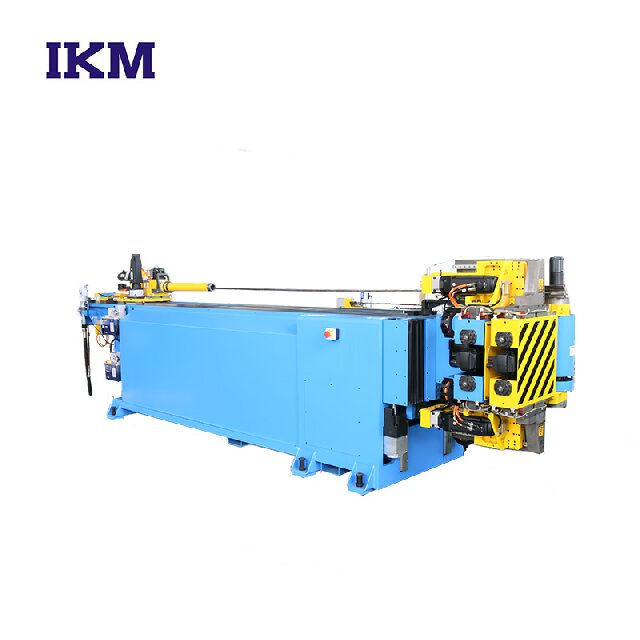
How exactly does this technology overcome physical interference? It relies on advanced mechanics for continuous forming. The equipment handles in-process left and right pipe bending seamlessly. The bend head actively rotates or shifts along a specialized carriage. It dynamically changes planes to reverse the bending direction. Crucially, it never releases the workpiece during these mechanical transitions. The collet maintains a rigid grip on the raw material from start to finish. This continuous control defines the core advantage of bidirectional systems.
This design perfectly supports complex interference avoidance. The machine simply routes the material away from obstructions dynamically. You can easily process pre-flanged or end-formed tubes. In standard bending, a large flange often swings directly into the pressure die. Bidirectional capability allows the machine to swing the bend head under or over the tube. This facilitates pristine flange avoidance tube bending. You no longer need to weld flanges on after the bending process. This eliminates a costly, labor-intensive secondary welding operation entirely.
Furthermore, it masters highly convoluted paths flawlessly. The system integrates programmable X, Y, and Z axes seamlessly. The bidirectional head movement coordinates alongside these linear axes. You can consolidate convoluted multi-plane paths into a single automated cycle. Your operators just load the raw straight tube. They press start. They retrieve the finished, complex product seconds later. This level of automation handles serpentine HVAC coils and dense automotive fuel rails with zero intermediate handling.
Let us evaluate these systems objectively. We look at three primary technical evaluation lenses to guide your factory planning. First, consider cycle time versus handling time. Bidirectional machines offer a continuous, unbroken automated cycle. Unidirectional machines force a start-stop-reload reality upon your operators. Handling time often exceeds actual machine bending time on standard equipment. While a standard machine might bend faster per degree, the total floor-to-floor time severely lags behind a continuous bidirectional process.
Second, precision matters heavily in modern manufacturing. The bidirectional system keeps the tube clamped securely inside the collet. It stays secured for the entire manufacturing process. This eliminates dangerous tolerance stack-up errors. Re-chucking a part always introduces minor deviations. A fraction of a degree error at the clamping point translates to massive dimensional shifts at the end of a long tube. Keeping the material locked in place guarantees absolute repeatability across thousands of cycles.
Third, carefully examine your factory floor space. A bidirectional machine looks physically complex and often occupies a larger immediate footprint. However, it optimizes your overall floor layout significantly. It often replaces two separate manual stations. You no longer need distinct right-hand and left-hand benders sitting side by side. You also eliminate the staging racks previously required for intermediate parts waiting for their second operation.
Table: Performance Comparison Between Bending Systems
Evaluation Metric | Standard Unidirectional CNC | Bi-directional CNC System |
|---|---|---|
Handling Requirements | High (Requires manual flipping and re-clamping) | Zero (Continuous automated forming) |
Tolerance Stack-up Risk | High (Re-chucking introduces measurable deviations) | Minimal (Tube remains clamped throughout the cycle) |
Pre-flanged Tube Compatibility | Poor (Frequent machine body collisions) | Excellent (Dynamic head shifts to avoid interference) |
Floor Space Utilization | Often requires two separate machines and staging racks | Consolidates operations into one optimized footprint |
We must acknowledge the hurdles of adoption transparently. Transparency builds trust when evaluating complex capital equipment. The advanced programming introduces a noticeable learning curve for your staff. Operators need advanced 3D spatial awareness. You must utilize sophisticated collision-simulation software. Programming bidirectional paths blindly is dangerous. The shifting head can easily collide with the machine frame if programmed incorrectly. Simulation software ensures safe, verified tool paths before any physical material enters the machine.
Tooling requires specialized, calculated investments. You will need specific offset dies to clear the rotating head mechanisms. Dual-direction mandrels are often mandatory for internal support. Standard mandrels only articulate in a single direction. When performing multi-plane tube bending that reverses direction, the mandrel must flex both ways smoothly. Extremely tight bend radii might demand entirely custom tooling solutions. You should partner closely with your tooling supplier during the machine procurement phase.
Maintenance requires strict, uncompromising attention. The shifting bend head introduces additional moving parts into the environment. You must manage extra servo axes and complex gearboxes. This demands a rigorous preventative maintenance schedule. It exceeds the daily requirements of standard, fixed-head benders. Lubrication routines must be strictly followed. Any mechanical slop in the rotating head directly degrades your final part tolerances.
Always run complete 3D kinematic simulations before executing a new part program physically.
Establish a strict daily lubrication schedule for the shifting head carriage and servo tracks.
Train at least two primary operators on the advanced CAD/CAM software to prevent knowledge bottlenecks.
Inspect dual-direction mandrels weekly for excessive wear on the articulating links.
Do you actually need this advanced technology? Use an application-first approach to decide. Evaluate your current facility workflows carefully. Bidirectional bending makes sense under specific, identifiable conditions. It is not merely a luxury upgrade. It is a targeted solution for severe production bottlenecks. You must analyze your actual part drawings, not just machine specifications.
Consider these primary success criteria for justification. Bidirectional equipment fits perfectly if you face:
High volumes of asymmetrical, multi-plane parts that require continuous forming.
Frequent machine collisions caused by complex part geometry or pre-installed hardware.
Excessive scrap rates directly tied to manual part handling and re-clamping errors.
You must balance the initial capital expenditure carefully. Weigh it against long-term labor savings and reduced scrap material. Think deeply about your capability expansion. Can you take on more complex contract manufacturing jobs? Upgrading your equipment opens new revenue streams previously blocked by technical limitations. Bidding on complex aerospace or EV cooling lines becomes highly realistic.
Follow these specific shortlisting next steps before committing to procurement:
Conduct a detailed time-study of your current manual flip-and-bend process.
Request a complete collision-simulation from the machine manufacturer using your most difficult part drawing.
Compare the projected automated cycle time strictly against your established baseline.
Evaluate your current tooling inventory to assess compatibility with bidirectional setups.
A bidirectional CNC system is not a universal necessity for every fabrication shop. Instead, it serves as a powerful strategic asset. It dramatically overcomes specific constraints of complex, high-interference tube paths. It eliminates manual handling bottlenecks entirely. You standardize production, eliminate operator-induced variables, and secure perfect repeatability.
Embrace this technology to modernize your manufacturing floor. Stop wasting valuable labor hours on manual repositioning and secondary welding operations. We encourage you to request a custom cycle-time analysis today. Submit your most challenging, interference-prone tube drawings for a comprehensive machine simulation. Validate your expected production improvements and step into a more efficient manufacturing future.
A: Yes. The ability to shift the bending direction dynamically allows for precise flange avoidance. The machine routes the tube away from the chassis. This prevents devastating collisions between the pre-installed hardware and the machine body during complex routing.
A: When programmed correctly, it actively decreases material stress. It eliminates the inconsistent manual handling and re-clamping of the material. This provides a continuous, highly controlled forming process. You avoid unpredictable work-hardening caused by interrupted bending cycles.
A: Standard push or rotary draw bending operates exclusively in a single fixed direction. Left and right bending implies the machine head can articulate. It bends the tube both clockwise and counter-clockwise within the exact same cycle. This capability is essential for completing multi-plane geometries without removing the workpiece.


