


Views: 0 Author: Site Editor Publish Time: 2026-09-03 Origin: Site


Achieving perfect tube bending accuracy is rarely just a mechanical challenge. It is fundamentally a software and control issue. High scrap rates and assembly fitment failures usually stem from inconsistent machine instructions rather than pure hardware faults. The industry has transitioned from manual or basic NC bending to highly advanced programming. Today, a modern CNC Tube Bending Machine uses predictive algorithms and real-time feedback. It controls the Y (distance), B (rotation), and C (bending) axes simultaneously. We rely on these digital capabilities to turn complex geometries into repeatable physical parts. Evaluating bending equipment requires understanding exactly how the programming environment dictates final tolerances. You must look beyond the iron to see how software ensures production reliability. We will explore how algorithms, hardware synchronization, and operator interfaces work together to guarantee precision.
CNC programming improves accuracy primarily through predictive springback compensation and 3D collision simulation.
The drive type of the machine (electric vs. hydraulic) dictates how precisely software commands are executed.
Software integration with CAD/CAM systems eliminates manual data entry errors.
True precision requires bridging the gap between programming capabilities and raw material consistency; software cannot fix highly variable tubing.
When we look at production bottlenecks, bending inaccuracies often lead the pack. You might not see the true damage at the bending station itself. It usually surfaces later down the manufacturing line. Poor precision increases scrap rates and forces secondary adjustment operations. Downstream fitment failures in welding or final assembly become inevitable. If a fabricated tube deviates by just a fraction of a degree, it will fail to align inside a welding jig. This misalignment creates severe production delays.
Traditional methods fail at scale for very obvious reasons. Manual adjustments rely heavily on tribal knowledge. Experienced operators might instinctively feel how a particular batch of metal bends. However, they cannot replicate this intuition perfectly across a thousand parts. People also retire or change shifts. CNC programming removes this guesswork entirely. It relies on repeatable, data-driven parameters. We program the exact angles, feeds, and speeds into the console. The software dictates the operation flawlessly every single time.
You should measure a successful bending operation by its first-part-correct rate. Every time you tweak a program to get the first usable part, you lose valuable time. Minimal cycle-time variation is equally critical. The machine must produce the hundredth part at the exact same speed and accuracy as the first. Robust software programming makes this level of consistency achievable.
Modern algorithms calculate how metals behave under extreme stress. They transform theoretical CAD models into physical reality seamlessly. Let us examine the core programming mechanisms driving this precision.
Springback Calculation and Material Libraries: Metals possess inherent elasticity. When you bend a steel or aluminum tube, it naturally attempts to return to its original shape. We call this phenomenon springback. Modern software stores empirical data on material elasticity within extensive libraries. When you input a specific alloy and wall thickness, the software automatically over-bends the tube. It calculates the precise degree of over-bend needed to achieve the exact target angle after the material relaxes. You no longer have to guess or run endless test pieces.
3D Simulation and Collision Detection: Complex tube profiles often twist back onto themselves. This creates a high risk of the tube crashing into the machine bed or tooling. Virtual prove-outs prevent these physical collisions. The programming software simulates the entire bending sequence inside a 3D environment. It ensures the programmed path is entirely viable before you load any raw material. If a collision is imminent, the software halts the process. It will then suggest alternative B-axis rotations to clear the machine architecture safely.
Elongation and Wall Thinning Prediction: Bending stretches the outer radius of a tube and compresses the inner radius. This action stretches the material and causes wall thinning. Advanced algorithms adjust the carriage feed (Y-axis) during the actual bend (C-axis) to control material flow. By pushing the tube into the bend die at a synchronized rate, the software minimizes dangerous thinning. It maintains structural integrity and prevents premature part failure in the field.
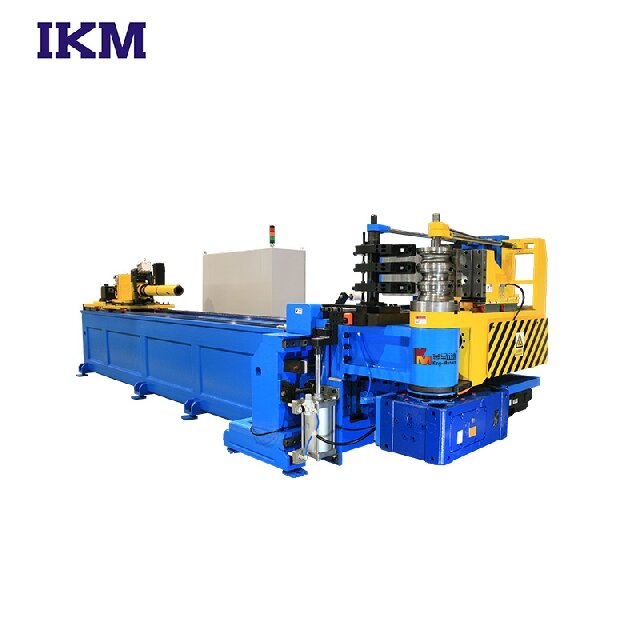
Software accuracy is only as good as the hardware executing it. Different machine architectures respond differently to identical programming inputs. You must match the control software with the appropriate drive type for your application.
Drive Architecture | Software Feedback Mechanism | Primary Application | Accuracy Control Profile |
|---|---|---|---|
Full Electric | Instant closed-loop servo feedback | Aerospace, automotive, complex geometries | Absolute positioning without thermal drift |
Proportional Hydraulic | Fluid valve latency compensation | Heavy structural tubing, thick-walled pipes | Requires software temperature adjustments |
Bidirectional | Continuous left/right vector execution | Furniture, symmetrical parts, multi-radii | Eliminates part removal and repositioning errors |
We consider the full electric CNC tube bender as the absolute gold standard for programmed accuracy. Servo motors drive every axis directly. These motors provide instant, closed-loop feedback to the main software. If a minor deviation occurs, the system corrects it in milliseconds. This instantaneous response eliminates the drift commonly found in older fluid-driven systems. You get exact positioning without relying on temperature-dependent fluids.
For high-strength, heavy-wall applications, a CNC hydraulic pipe bender remains a highly practical choice. However, programming these machines requires a different mathematical approach. The software must account for hydraulic fluid temperature changes. As oil heats up throughout a production shift, its viscosity changes slightly. This alters how the machine responds to valve commands. Advanced algorithms compensate for proportional valve latency to maintain accuracy. We see modern hydraulic machines closing the accuracy gap through these smarter control loops.
Symmetrical or highly complex shapes present unique challenges. Implementing bidirectional CNC tube bending simplifies these challenging workflows. Right-and-left bending capability reduces the need to remove and reposition complex parts midway. You avoid multi-setup alignment errors entirely. The software executes a single, continuous program. It shifts the bend direction dynamically, keeping the part locked in the collet the entire time.
Buyers often focus too heavily on machine mechanics. You must evaluate the software interface as rigorously as the machine iron. Look for these critical criteria when assessing a new system.
CAD/CAM Integration (STEP/IGES): You should demand the ability to import 3D models directly into the control system. Direct importing bypasses manual XYZ-to-YBC coordinate conversions. Manual data entry is where most human error occurs. When operators type hundreds of coordinates by hand, typos are inevitable. Direct STEP or IGES file integration eliminates this risk completely.
In-Process Measurement & Closed-Loop Corrections: Assess whether the software integrates seamlessly with optical measurement arms like ROMER or Faro. These devices scan a bent tube and compare it to the CAD model. The software automatically calculates and applies correction matrices to the baseline program. This closed-loop system fine-tunes the program without requiring manual mathematical recalculations.
Operator UI and Error-Proofing: Look for systems designed to restrict out-of-parameter manual overrides. Operators sometimes try to force a machine to perform outside its mechanical limits. Good software locks down critical parameters. It ensures the machine runs exactly as engineered rather than as modified by an aggressive floor operator. Visual interfaces also help operators troubleshoot issues quickly.
Transitioning to advanced digital bending brings tremendous benefits. However, we must acknowledge a few hard implementation truths. You need to manage these realities to achieve stated production goals.
We must address the material variable first. The absolute best programming cannot compensate for highly inconsistent raw material. If tubing features fluctuating wall thickness, accuracy will suffer. If tensile strength varies wildly from batch to batch, the springback calculations will miss the mark. Software assumes a baseline material consistency. You must source quality tubing to leverage the true power of CNC control.
Tooling calibration presents another major hurdle. Software assumes perfect mechanical baseline conditions exist on the shop floor. The math relies on tooling being set correctly. If wiper dies, mandrels, or bend dies are worn out, programmed accuracy will degrade rapidly. If an operator sets the clamp die pressure incorrectly, the tube will slip. The software will push the Y-axis forward, but the physical tube will lag. You must maintain rigorous tooling standards.
Finally, we must address the operator skill gap. Shifting to advanced CNC programming requires a profound cultural change. You are transitioning operators from mechanical feel to digital troubleshooting. They must learn basic data management, CAD file handling, and software navigation. Training is critical here. If you buy an advanced machine but fail to train your staff, they will revert to manual overrides. Invest in comprehensive software training during the rollout phase.
CNC programming turns bending from a dark art into a repeatable, data-driven science. By leveraging predictive algorithms and 3D simulation, modern systems eliminate the guesswork that plagued traditional fabrication. Software bridges the gap between a theoretical CAD model and a perfectly executed physical part.
When you evaluate vendors, do not just focus on the heavy iron. You should request a live software demo using your most complex part file. Watch how the system imports the data, calculates springback, and checks for collisions. The software interface will dictate your daily operational efficiency.
Your next step should involve consulting directly with equipment manufacturers. Ask them to run a cycle-time and tolerance simulation on your specific production materials. This digital prove-out will clearly demonstrate the precise capabilities of their control systems before you make a purchasing decision.
A: Modern software uses extensive material databases containing empirical elasticity data. You select the metal type and thickness. The software applies a proportional over-bend algorithm. It calculates how far past the target angle the machine must push the tube so it relaxes back to the exact required position.
A: Yes. The software precisely synchronizes the boost block pressure and mandrel retraction timing. By adjusting the carriage feed rate during the bend, the program controls material flow. This prevents the inner radius from wrinkling and stops the outer radius from tearing.
A: No. While electric machines offer the tightest absolute tolerances, modern proportional hydraulics benefit massively from advanced CNC controls. Upgraded software loops compensate for fluid latency and temperature shifts, offering a massive accuracy upgrade over conventional hydraulic methods.
A: With direct CAD integration, a complex multi-bend profile takes minutes rather than hours. The software imports the 3D file, converts XYZ coordinates to YBC machine data, simulates the sequence, and calculates springback almost instantly.


