


Views: 0 Author: Site Editor Publish Time: 2026-10-26 Origin: Site


Non-square cuts in aluminum extrusions like 2020 or 4040 profiles cause major manufacturing headaches. They lead to compounding assembly errors and rejected parts. Ultimately, these inaccuracies introduce severe structural weakness in custom framing. Achieving a perfect 90-degree cut requires absolute mechanical precision. Slight angular deviations cascade into significant alignment issues during final product assembly. This forces fabrication teams to waste countless hours on manual deburring and corrective milling.
We will explore the mechanics behind cut deviation and how you can permanently prevent it. You will learn how to evaluate different cutting tools based on your specific production scale. We provide a complete technical framework to help you achieve consistent, burr-free, perfectly perpendicular cuts every single time.
Achieving true 90-degree squareness relies heavily on the synergy between rigid material fixturing and blade stability, not just the cutting tool.
For low-to-medium volumes, a calibrated aluminum cutting saw with a Triple Chip Grind (TCG) blade and zero-clearance inserts is the baseline requirement.
For high-volume industrial production, transitioning to an Automatic Tube Cutting Machine mitigates operator fatigue and ensures repeatable precision.
Blade deflection and improper clamping pressure are the leading causes of angular deviation; upgrading machinery is only effective if feed rates and lubrication are standardized.
Understanding why aluminum profiles lose squareness is the first step toward correcting the issue. Angular deviation rarely stems from a single failure point. Instead, it usually results from a combination of mechanical instabilities during the cutting process. You must identify these risks before adjusting your equipment.
Blade deflection happens when the cutting blade bends slightly out of its intended vertical path. High feed rates often push the blade harder than it can cut. This forces the blade to "walk" along the path of least resistance. Incorrect blade thickness also contributes to this problem. Thin-kerf blades save material but lack the rigidity needed for perfectly square cuts. When a blade deflects, it leaves a distinct beveled edge on your extrusion.
Aluminum extrusions, especially T-slots and thin-walled profiles, are vulnerable to crushing. Excessive clamping force temporarily deforms the extrusion. The saw then cuts this distorted shape perfectly straight. However, once you release the clamp, the aluminum springs back to its original shape. The cut face immediately pulls out of square. Uneven clamping pressure creates the exact same problem.
Machine vibration destroys cut precision. Inadequate machine mass fails to absorb the kinetic energy generated during a cut. Improper RPM settings create harmonic resonance. This chatter translates directly into the material.
Chatter Marks: Visible ridges left on the cut surface due to lateral blade movement.
Burrs: Jagged aluminum edges pushed out rather than sheared cleanly.
Micro-Deviations: Tiny angular shifts in the cut face, compounding over long assemblies.
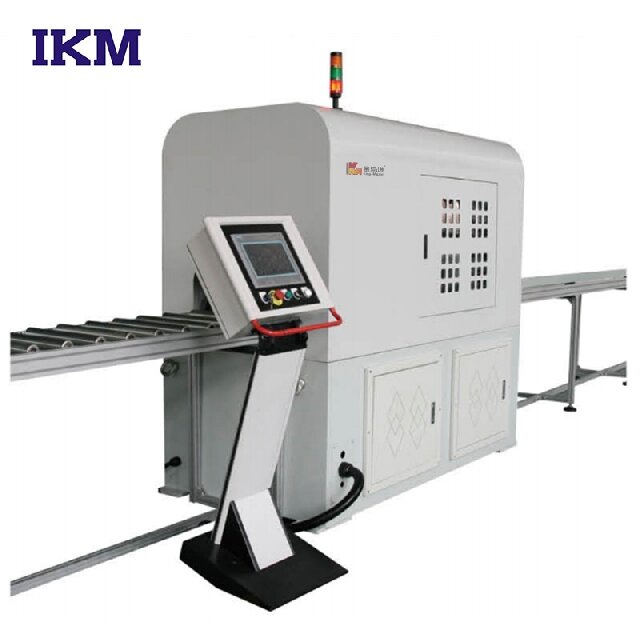
You must align your equipment choices to your specific production volume. Using an underpowered tool for industrial batches leads to rapid failure. Over-investing in massive machinery for hobbyist tasks wastes capital.
Many fabricators start using DIY methods. They often modify standard woodworking miter saws using specialized non-ferrous blades. This approach works for occasional prototype cuts. However, these entry-level setups have severe limitations. They lack the repeatability required for batch processing. Their motors overheat quickly under continuous duty cycles. You cannot rely on them for consistent, high-tolerance squareness.
When upgrading, you must choose between different dedicated saw architectures. Each design offers unique mechanical advantages.
Upcut Saws: The blade rises from beneath the table. This provides superior safety because the blade remains mostly hidden. Upcut designs offer excellent hidden blade stability. They also allow gravity to assist chip evacuation downward.
Drop/Chop Saws: The blade descends from above. They provide excellent versatility for different angles. They generally require a smaller workshop footprint. However, you must actively manage chip extraction to prevent recutting debris.
The trunnion is the core mounting bracket holding the saw arbor. You must evaluate the weight and construction of the saw base. Cast-iron construction absorbs vibration far better than stamped steel. A heavy machine base is a non-negotiable metric. It guarantees long-term precision. When evaluating an aluminum cutting saw, check the arbor runout specifications. Heavy-duty trunnions keep the arbor perfectly parallel to the fence.
Machine Type Comparison Table
Equipment Type | Ideal Volume | Vibration Control | Squareness Reliability |
|---|---|---|---|
Modified Miter Saw | Low / DIY | Poor | Inconsistent |
Industrial Drop Saw | Medium | Good | High (requires manual pacing) |
Enclosed Upcut Saw | High | Excellent | Very High |
Manual cutting creates bottlenecks as your production volume increases. Human operators naturally vary their feed rates throughout a shift. This variability affects cut quality directly.
Operator-dependent feed rates lead to inconsistent blade deflection. Plunging the blade too fast causes it to bend. Plunging too slowly causes heat buildup and premature tool wear. An automated system removes this human error entirely. It maintains a constant, optimized feed rate from the first cut to the last.
Upgrading to a High-Speed Aluminum Disc Saw Machine with PLC Control transforms your workflow. Programmable logic controllers (PLC) allow for exact feed rate management. You can optimize the exact chip load per tooth. This prevents both bogging down and excessive heat.
Feed Optimization: The PLC adjusts the blade descent speed automatically based on material resistance.
Clamping Consistency: Automated pneumatic clamping sequences apply the exact required pressure. They prevent the profile distortion common in manual setups.
Scrap Reduction: Servo-driven material pushers measure lengths down to a fraction of a millimeter.
Many facilities wonder if a standard Tube Cutting Machine can handle complex extrusions. Standard machines generally focus on round or square tubing. However, you can often retool them for complex T-slot extrusions. You must assess if the machine accepts custom jaws. Adapting the equipment for architectural profiles requires specialized pneumatic grip adjustments.
Best Practice: Always request custom soft jaws when purchasing an Automatic Tube Cutting Machine for T-slots. Standard V-blocks will crush the delicate internal channels.
The most rigid saw will still produce terrible cuts if you use the wrong blade. Aluminum requires very specific tooth geometry. Woodworking blades will grab, tear, and ruin the metal.
The Triple Chip Grind (TCG) is the absolute industry standard for cutting non-ferrous metals. A TCG blade alternates between a flat top tooth and a slightly taller chamfered tooth. The chamfered tooth roughs out the center of the cut. The flat tooth clears the corners. This geometry prevents grabbing and tear-out. Alternate Top Bevel (ATB) blades, commonly used for wood, slice aggressively. They will snag on aluminum and destroy the cut squareness.
You must balance your tooth count against the extrusion wall thickness. A widely accepted rule of thumb dictates keeping 2 to 3 teeth in the material at all times. This prevents the material from dropping between the teeth and snagging.
Thin-Walled Tubes: Require a higher TPI (Teeth Per Inch) blade to maintain continuous engagement.
Solid Extrusions: Require a lower TPI blade to allow adequate gullet space for chip evacuation.
The rake angle determines how aggressively the tooth attacks the material. Aluminum blades require a negative or zero rake angle. A positive rake angle pulls the blade self-feed aggressively into the aluminum. This causes sudden kickback and massive blade deflection. A negative rake pushes the material slightly downward, stabilizing it against the table during the cut.
Common Mistake: Repurposing an 80-tooth wood blade for aluminum. Even if the tooth count seems high enough, the positive rake angle will cause immediate grabbing and safety hazards.
Process reliability demands strict standardization. Even a premium CNC-controlled saw will fail completely if you fixture the workpiece incorrectly. Never assume a good machine compensates for bad clamping.
Aluminum generates intense friction when cut. Without lubrication, the aluminum heats up and becomes gummy. It will quickly gall and weld itself directly to the carbide teeth. This ruins the blade balance and immediately destroys cut squareness. Continuous cooling is absolutely mandatory. Micro-Drop Lubrication (MQL) applies a microscopic mist of oil directly to the cutting edge. This reduces heat without leaving the extrusion dripping in messy coolant.
Complex profiles tend to roll or twist under clamping pressure. Standard flat fences cannot stabilize an irregular shape properly. Utilizing custom jigs solves this completely.
Soft Jaws: Use 3D-printed or machined soft jaws matched to the exact profile of your extrusion. These distribute clamping force evenly.
Zero-Clearance Fences: Attach a sacrificial backer board to the fence. Cut through it once. This provides rigid support directly up to the blade edge.
Overhead Clamping: Apply downward pressure in addition to lateral pressure. This prevents the material from lifting as the blade exits.
These fixturing steps prevent the material from shifting off-axis. They are the secret to achieving consistent end squareness.
Achieving perfectly square cuts in aluminum extrusions requires a systematic approach. You must eliminate blade deflection, standardize your clamping force, and utilize proper TCG tooling. Base your final equipment investment strictly on your volume and tolerance requirements.
Low-volume precision requires meticulous manual calibration of heavy-duty saws. High-volume predictability necessitates removing the human element entirely via automated machinery. Automated clamping and PLC-controlled feed rates guarantee consistency across thousands of cuts.
Audit your rejection rates: Calculate the exact labor hours your team spends on manual deburring or corrective milling.
Standardize tooling: Verify your shop exclusively uses negative-rake TCG blades for all aluminum profiles.
Request test cuts: Send your specific aluminum profiles to machinery manufacturers before purchasing. Inspect the end squareness yourself.
A: Yes. By utilizing a highly rigid saw, a negative rake TCG blade, and precision soft-jaw clamping to eliminate deflection, you can achieve mill-quality squareness directly from the saw.
A: This typically indicates a lack of parallelism in the fence, a bent blade arbor, or uneven clamping pressure causing the material to shift off-axis as the blade makes contact.
A: RPM depends entirely on blade diameter and material thickness, but generally, surface speeds of 10,000 to 12,000 SFM (Surface Feet per Minute) are targeted for aluminum, combined with a controlled feed rate to ensure proper chip evacuation.
A: Yes, provided the clamping mechanism can securely hold the non-cylindrical shape without crushing the delicate internal channels. Custom clamping jaws are highly recommended.


